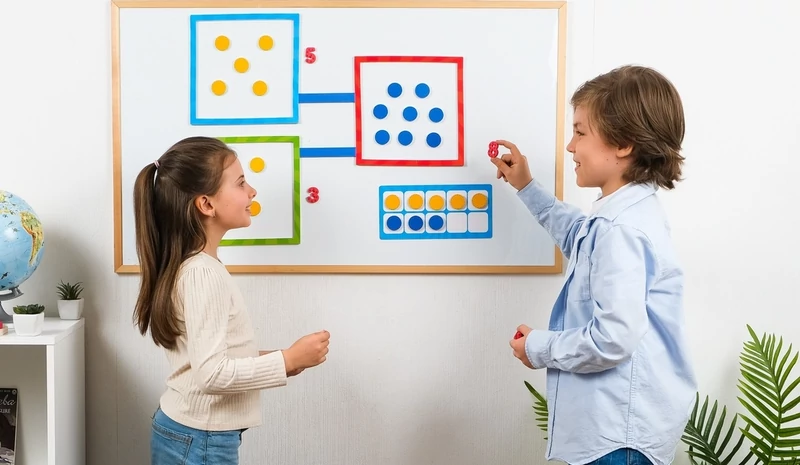
From first-grade counting to middle school algebra, drawings and diagrams turn numbers into something your child can see and make sense of.
For students who feel lost in multi-step problems or overwhelmed by abstract symbols, visual strategies offer clarity. A well-placed bar or number line can shift math from something confusing into something concrete.
Building on that idea, Mathnasium of Queen Creek shares 5 practical ways you can use visuals to help your child develop stronger number sense, better reasoning skills, and a deeper understanding of math.

What Is Visual Math?
Visual math is the use of drawings, diagrams, and other spatial models to represent mathematical ideas. Instead of relying only on numbers and symbols, students use visual tools to make sense of concepts that might otherwise feel abstract or confusing.
Say a student is solving 4 × 6. To help them see what the problem means, you draw four circles with six dots in each. The sketch shows four equal groups, and the student now sees a concrete picture of what multiplication represents.
That’s visual math in action.
Research shows that using visual models in math helps students solve problems more effectively, not just by making things clearer, but by lightening the mental load.
When a diagram holds part of the information, students have more space to focus, reason, and work through complex ideas. That added clarity often leads to stronger problem-solving skills and better learning over time.
We’ve seen this play out at Mathnasium as well.
When a student hesitates or gets stuck, a simple drawing often changes the pace. The visual takes some of the pressure off their thinking, so they can stop juggling steps in their head and start focusing on the problem itself. That’s usually when the “aha” happens.
📕 You May Also Like: How to Teach Math to Visual Learners with Pictures & Manipulatives
5 Ways to Use Drawings and Diagrams for Math Problems
Visual tools don’t need to be complicated to be effective. In fact, the simplest drawings are often the ones that help a child finally see what the problem is asking.
Let’s look at 5 practical ways to use diagrams and sketches to bring clarity to math at home.
1. Number Bonds for Breaking Down Numbers
Before students can add or subtract with confidence, they need to understand how numbers are built. At Mathnasium, we often start with number bonds to help students see how numbers connect and come apart.
A number bond is a simple diagram, usually a large circle connected to two smaller ones, that shows how a number can be split into parts.
For example, if the whole is 8, the parts might be 5 and 3. That visual relationship helps children understand that 5 + 3 = 8, and that 8 – 5 must equal 3.
This sort of part–whole thinking helps students understand that numbers aren’t just facts to memorize, but quantities that can be broken down and recombined in different ways.
To support your child’s early math learning, you can use number bonds in a few simple yet effective ways:
-
Decomposing for Mental Math: A student who knows that 7 + 3 = 10 can use that bond to solve 7 + 5 by splitting the 5 into 3 and 2. They combine 7 and 3 to make 10, then add the remaining 2 for 12.
-
Missing Part Problems: If a student sees 9 = __ + 4, they can use the bond to figure out what fits. Instead of guessing, they’re thinking in parts.
-
Fact Families: From one number bond (like 6, 4, and 10), students can generate multiple facts, like addition and subtraction, that all work together.
Even though they look simple, number bonds do a lot of heavy lifting behind the scenes. By using them early and often, students begin to see patterns, spot shortcuts, and solve problems confidently.
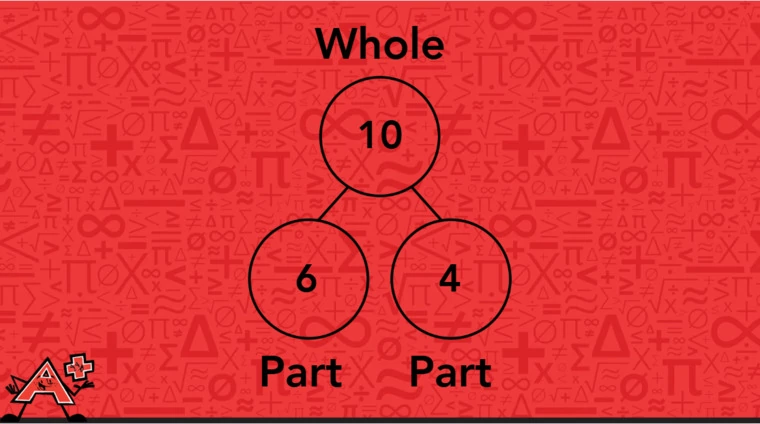
A number bond shows how parts come together to form a whole and how a whole can be broken into parts.
2. Equal Groups for Multiplication and Division
One of the simplest and most effective drawings we use when introducing multiplication or division is a picture of equal groups.
Why?
Because multiplication isn’t just about numbers. We want to show that it’s about quantity and structure. Equal groups help students see what “3 × 5” actually means: three groups with five in each.
How do you do it?
Couldn’t be simpler. If you want to show 3 × 5, just draw three circles and place five dots, stars, or tally marks inside each one. Your child can count all the dots to find the total, no guessing, no memorization required.
It works in reverse, too. If you’re solving 18 ÷ 3, draw three circles and divide 18 dots evenly among them. The drawing reveals that each group ends up with 6.
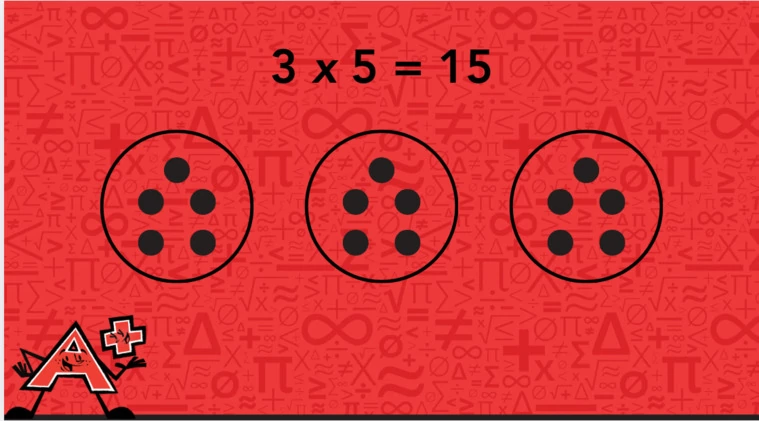
A simple drawing of equal groups turns multiplication into something students can see and count.
3. Number Lines for Operations or Comparisons
Next up is one of the most versatile visuals in early math: the number line.
At Mathnasium, we love number lines because they show math as movement.
Students can follow jumps forward or backward to understand how numbers change with each step, whether they’re adding, subtracting, or comparing values.
Number lines can support various kinds of math thinking:
-
Addition
-
Subtraction
-
Working with negative numbers
-
Comparing values, including fractions and decimals
-
Understanding the distance between numbers
The design is simple: sketch a straight horizontal line, mark off evenly spaced numbers, and use arrows or hops to show what’s happening.
You can use number lines to clarify math problems, such as:
-
Addition: To solve 7 + 3, start at 7 and draw three hops to the right. You land on 10.
-
Subtraction: To solve 9 – 4, start at 9 and hop four spaces to the left. The answer is 5.
- Negative Numbers: Start at –2 and add 4 by hopping four steps to the right. You land on 2.
- Comparing Fractions: Plot \(\Large\frac{1}{3}\) and \(\Large\frac{1}{2}\) on a number line divided into sixths. It’s easy to see that \(\Large\frac{1}{2}\) is farther to the right and therefore greater.
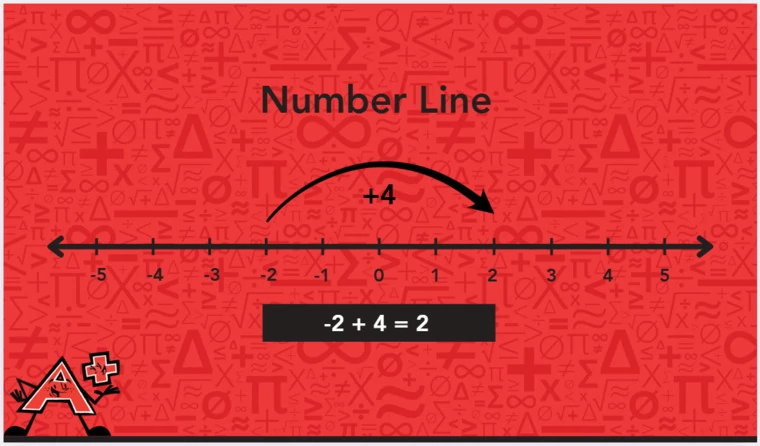
Number lines are a simple way to show how numbers move: forward, backward, above or below zero.
4. Bar Models for Parts, Wholes, and Relationships
Another versatile tool to add to your visual arsenal is the bar model, also called a tape diagram.
At Mathnasium, we bring in bar models when a student needs help organizing a word problem, visualizing a fraction, or breaking down a ratio.
We recommend these to parents as they’re simple and fast to sketch.
You can start with a bar (a long rectangle). Break it into sections based on the parts of the problem, label what you know, and leave a space for what you need to find.
Across different math problems, that might look like this:
-
Part–Whole Problem: “There are 3 shelves with 6 books each. How many books are there in total?” Draw a bar divided into 3 equal sections. Label each section with a 6. The total is found by adding or multiplying the parts: 3 groups of 6 equals 18 books.
-
Fraction Problem: “Add \(\Large\frac{1}{2}\) and \(\Large\frac{1}{4}\) . What’s the total?” Draw two bars of equal size. In the first bar, shade one of the two equal parts to show \(\Large\frac{1}{2}\) . In the second bar, divide it into four equal parts and shade one to show \(\Large\frac{1}{4}\) . When you stack or compare the shaded parts side by side, students can clearly see that the combined shaded portion is three out of four parts, so the total is \(\Large\frac{3}{4}\) .
-
Ratio Problem: “A recipe uses a 2:3 ratio of oil to vinegar. If you use 4 tablespoons of oil, how much vinegar do you need?” Draw a bar made up of 2 parts labeled oil and 3 parts labeled vinegar. Since the oil portion has been doubled (from 2 to 4), the vinegar portion must double as well, from 3 to 6.
If you're looking to dive deeper into part–whole relationships and how they connect to fractions, we have a detailed guide you can explore.
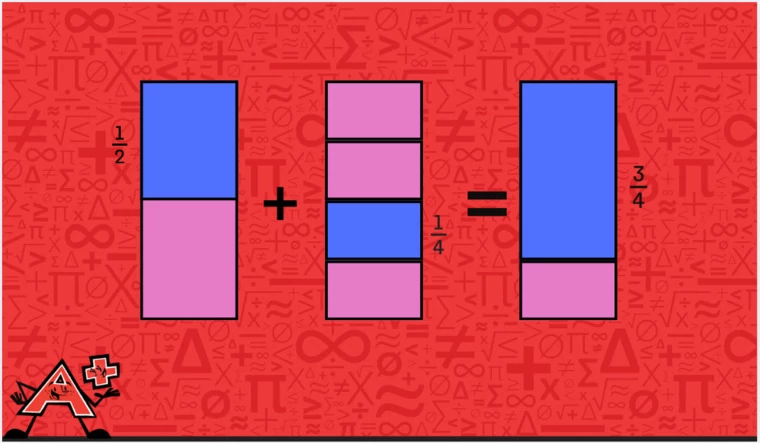
Bar models make it easier to see how fractional parts relate and combine.
5. Area Models for Multiplication
Some multiplication problems are easier to solve when students can break the numbers into parts and see how those parts contribute to the whole.
This is where area models come in.
An area model is a rectangular diagram that shows multiplication as the total area of smaller sections. It helps students organize partial products, especially with two-digit numbers, so they don’t have to solve everything at once.
Think of it like a visual version of long multiplication, only with boxes instead of steps.
How does it work?
Say we want to solve 12 × 13. Start by breaking each number into its place value parts: 12 becomes 10 and 2, while 13 becomes 10 and 3. Then, draw a rectangle and divide it into four sections, one for each pair of parts.
In each section, multiply the numbers that meet:
-
10 × 10 = 100
-
10 × 3 = 30
-
2 × 10 = 20
-
2 × 3 = 6
Add all the pieces together: 100 + 30 + 20 + 6 = 156.
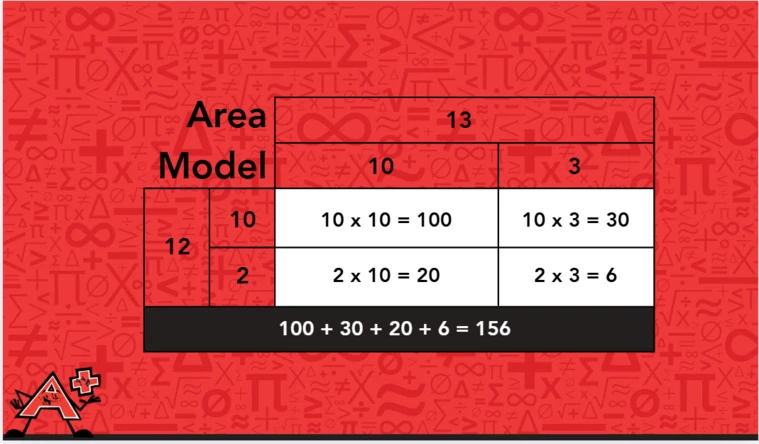
The area model keeps everything organized and helps students understand where each part of the answer comes from.
How Mathnasium Makes Math Click for Every Kind of Learner
We understand that not all students grasp math in the same way. Some are visual learners who benefit from diagrams, models, and hands-on tools. Others are verbal learners who thrive through discussion and explanation. Some prefer to work things out mentally, while others rely on written steps to stay organized.
That’s why the Mathnasium Method™, our proprietary teaching approach, is designed to make math make sense for every kind of learner.
Each student begins their Mathnasium journey with a diagnostic assessment. This not only helps us identify areas of strength and improvement, but also gives us insight into how a student learns best, whether visually, verbally, kinesthetically, or through a combination of methods.
With these insights, we create a personalized learning plan tailored to their unique needs and learning style.
From there, our specially trained instructors deliver face-to-face instruction in a focused, engaging small-group setting. Throughout each session, we blend verbal, mental, visual, tactile, and written strategies to match how the student learns best. Many of our activities are game-based or use hands-on materials to bring math to life.
The goal isn’t just to help students get through their homework. It’s to help them understand the “how” and “why” behind each concept so they develop real problem-solving skills, stronger critical thinking, and a lasting confidence in math.
And the results?
-
94% of parents report an improvement in their child’s math skills and understanding.
-
90% of students see better grades at school.
-
93% of parents observe a more positive attitude toward math after attending Mathnasium.
With over 1,100 learning centers across the U.S., Mathnasium brings top-rated tutors and a proven teaching method to communities nationwide.
Mathnasium of Queen Creek serves students in Queen Creek and Gilbert, AZ, and has years of experience helping students transform how they think and feel about math. Families regularly share how this approach has changed not just grades, but confidence, too.
Here’s what one parent shared:
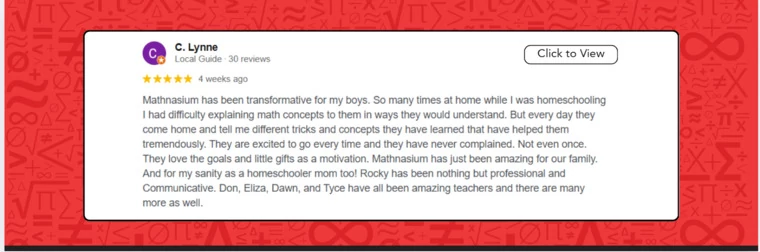
If you're looking to help your child catch up, keep up, or get ahead in math, reach out to schedule a diagnostic assessment, the first step toward lasting math success.


 (480) 279-3122
 (480) 279-3122