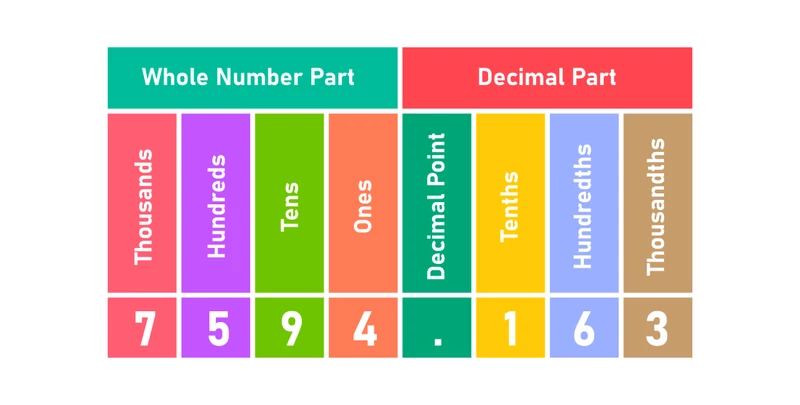






What is Place Value?
The value of the position of a digit in a numeral. Place values are determined as powers of 10, starting at the decimal point
Place value tells us what each digit in a number means, depending on where it appears. In our base-10 number system, each place has a different value, and each place is 10 times the value of the place to its right.
For example, in the number 3,472:
- The 2 is in the ones place, so it means 2.
- The 7 is in the tens place, so it means 70.
- The 4 is in the hundreds place, so it means 400.
- The 3 is in the thousands place, so it means 3,000.
This system also works with decimals:
- In 0.5, the 5 is in the tenths place (\(\Large\frac{1}{10}\)).
- In 0.25, the 2 is in the tenths place and the 5 is in the hundredths place (\(\Large\frac{1}{100}\)).
Understanding place value helps students:
- Read and write large numbers
- Compare and order numbers
- Perform addition, subtraction, multiplication, and division more confidently
When Do Students Learn About Place Value?
Students start learning place value early and keep building on it as they progress through school.
Grades K–2 – Introduction to Place Value
Students learn about the ones, tens, and hundreds places. They begin grouping numbers into tens and ones using blocks and visuals.
Grades 3–5 – Building Place Value Understanding
Students explore thousands and beyond, and work with decimals to the tenths and hundredths.
Grades 6+ – Applying Place Value in Advanced Math
Students use place value to understand decimals, scientific notation, and the metric system.